





A successful surgery at the Sewa Sadan Eye Hospital’s retina department saved the sight of Mahira – a 45-day-old preterm baby.
Mahira and her twin Meesha were born to a young couple Anikita and Sonu Soni in Bhopal. The twins born to the couple were preterm, delivered through cesarean in the eight months of pregnancy. They weighed a mere 1600 gms each. As the newborns were weak, parents were advised to admit the babies to Special Newborn Care Units ( SNCU) of a referral hospital as they were weak.
The parents who would have been enjoying the birth of their babies, were at the hospital caring for the babies fighting for their lives. After a month’s treatment in the SNCU, the babies were discharged from the hospital. But as the babies were pre-term, and low weight, the parents were now advised to consult a retina specialist. The family’s ordeal was yet not over.
The government district hospital at Sehore, a neighbouring district of Bhopal, referred Meesha and Mahira to Sewa Sadan Eye Hospital ( SSEH) for a retinal check up. Being low weight and having undergone treatment in SNCU, there could be a chance of RoP.
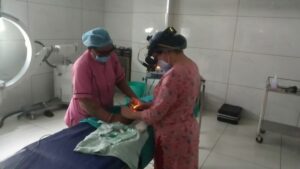
Pediatric retina specialist of SSEH Dr. Sonal Paliwal and Sr. retina optometrist Ajay Narwariya examined both babies. Fortunately, Meesha’s eyes were fine. But Mahira was diagnosed with Retinopathy of Prematurity ( ROP). The twins were just 45 days old.
Retinopathy of Prematurity (ROP) is a major cause of preventable blindness in children. It is estimated that of about 15 million children born preterm worldwide, about 53,000 develop sight-threatening ROP requiring treatment, and 20,000 suffer blindness or severe visual impairment.
Crucially, premature birth and LBW predispose a newborn to develop ROP.
Dr. Paliwal immediately took the decision and performed the laser procedure successfully on Mahira. As the case was outside of Bhopal, the hospital’s project team regularly followed up the case. Mahira is now recovered and like her name will grow to be knowledgeable.
Sewa Sadan Eye Hospital has a full-fledged RoP unit. The ROP project in Sewa Sadan have been launched with the support and efforts of Bengluru based philanthropist Manu Chhatlani. BKT Foundation of Balkrishna Industries Mumbai have donated Rs. 27 Lakh for Laser Machine and an Imaging Camera in SSEH.
For teenager Nisha, 19th January 2018, will always remain a memorable day. It was the day when she regained sight in both her eyes. A demure, hesitant Nisha’s face lit up into a delightful smile, as post-surgery, she could see the world clearly around her.
Growing up, Nisha’s childhood was tough. Due to cataract in both the eyes, she suffered from dimness of vision impacting her entire day -to day -activities. She could not attend school or play like other children with normal vision. She stayed home caring for her siblings.
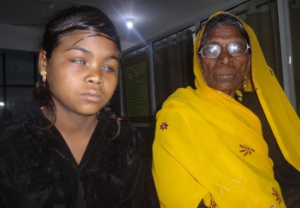 Nisha Solanki belongs to a large family of two brothers and four sisters (of whom 3 are married). Both her brothers and elder sister attend school. Nisha’s father is mentally challenged. The responsibility of earning is on the mother, who is a daily wage farm labourer and grandmother, who tends to her goats. Two earing members for a family of ten.
The family lives in a tiny village – Chokdi in district Harda of state Madhya Pradesh. The district houses one district hospital, and 4 CHC catering to a population of 5.7 lakhs. Lack of access to health facility coupled with low awareness of eye problems and inequality towards girl child seems to have sealed Nisha’s fate..
However, an eye screening camp by Sewa Sadan Eye Hospital turned Nish’a fortune for ever. At the camp held at the district, Nisha was advised for surgery at the main hospital in Bhopal – a distance of 4 hours from the village. Fearing opposition from the family, the 70 year old grandmother, Nandan Bai, took a bold decision and without informing her family accompanied Nisha to Sewa Sadan Eye hospital for a sight restoring surgery.
After all the pre – surgery protocols were completed successfully, Nisha underwent surgery for removal of cataract. The right eye was operated on 22/12/17. After 27 days, the left eye for operated for cataract. An intraocular lens (US Foldable) was implanted in both the eyes. We thank CBM for supporting the surgery.
It was the bold decision of Nandan Bai that restored Nisha’s vision.
 Blindness in children leads to deep impact on psychological, emotional, and socioeconomic growth to the family. A child with blindness is more likely to have delays in developmental milestones, to be more frequently hospitalized, and die during childhood than a sighted child. Such severe vision loss also adversely effects the educational activities, orientation, and mobility from the early stage of life resulting in lack of employment privilege. These differential characteristics between a sighted and non-sighted child is more obvious in developing countries. Moreover, the disability adjusted life years (DALY) loss in a blind child is far more than that of adults with blindness.